Thank You, Tim
For my first two Pastor Appreciation posts, I have a long history with the person I’m highlighting. For this entry, I have only a recent history and a still-evolving friendship, but I am truly grateful for it.
Meet Pastor Tim Norton.

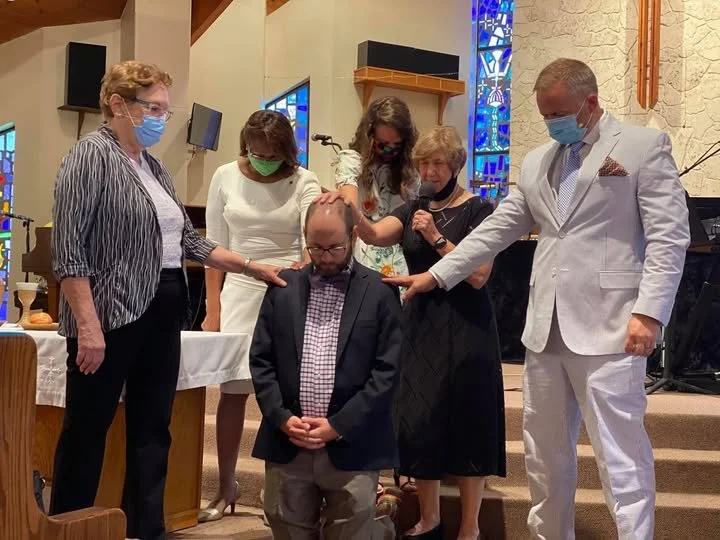
Tim Norton, seen here doing…something…with a table. Best image ever!
Tim is the Lead Pastor of Indian River Presbyterian Church, a church with a rich history in our community. While my connection to Tim is fairly recent, my connection to his church dates back to the early days of my ministry. As a young youth pastor, the then-youth pastor at Indian River Presbyterian, Iley befriended me and my friend Bronson, who co-pastored the youth ministry alongside me.
Over the years, the three of us helped each other in various ways, even as Iley mentored his eventual replacement, Alex. Iley and Bronson now serve elsewhere, and Alex has since moved on from the area, but all remain dear friends. I’ll likely share more in posts dedicated to them, but I'm sharing what I have here for context. Around the time of Alex’s transition out of Indian River Presbyterian Church (IRPC), he connected me with Tim – who had recently assumed the pastorate there – to start conversations about some technical projects the church needed done.
My first impression of Tim, which I don’t think I’ve ever told him before, but probably won’t come as a surprise to him, was as follows: “That guy has a lot of energy! Though I’m generally more reserved these days, I can still muster some zeal when I need to turn it on. Tim, on the other hand…well, I’m not sure he can turn it off! His energy spills out of him in his preaching, leadership, and everyday interactions with people.
At first, I thought this energy was simply a personality trait (a prominent one, though not a bad one!). I’m sure that’s part of it, but I don’t think it’s fair to say that’s the complete picture. Over time, I have learned that Tim’s energy and passion aren't just personality traits, but also byproducts of a sincere, deep commitment to the hard work of pastoring people.
I’ve witnessed this from afar. Being the “new guy” in an established place with a long, proud history is hard enough, but on top of that pressure, I know Tim has had to have hard conversations and make hard decisions in his few years at IRPC. I know some have worked out well. I imagine there are others he wishes he could take back or do differently. He’s certainly not perfect, but he doesn’t shy away from the tough things, and he actively avoids choosing his own comfort (which is, sadly, all too common in ministry). His dedication is admirable.
I’ve also had the opportunity to get to know him personally and experience his commitment firsthand. As you may know, my wife and I have two sons, Edmund and Benji. Two years ago, Benji was diagnosed prenatally with Hypoplastic Left Heart Syndrome (HLHS), a rare, life-threatening congenital heart defect. I don’t remember whether I told him the news or if he learned it when we started asking for help online. But what I do remember is how quickly he offered his help
Tim and his family are no strangers to child medical crisis and all it entails, having spent substantial time themselves in what we not-so-affectionately term “hospital life.” In the hands of some, experience can be unhelpful – situations are compared, advice is offered without reservation, and present struggles are dismissed by hindsight. But in the hands of others, experience informs an understanding perspective, a listening ear, and patient care.
This might be shocking, but this kind of work is hard in its own right. It is genuinely hard to be patient with strugglers when you want to convince them of the promises of God you believe so deeply. It is hard to listen when you are convinced you have something helpful to say. Sometimes, it is even hard to listen to someone’s situation because it so closely resembles your own.
I know this to be true because, for years, I was predominantly on one side of that setting – the side with the “experience” and “answers.” But in recent years, I have found myself on the opposite side, the side that was face-to-face with hardship, wrestling with uncertainty, and struggling with both my circumstances and my responses to them. Throughout, Tim has done hard work with and for me, regularly taking time to text to check in, and meeting with me several times to listen, pray, and offer his encouragement and insight only after humbly asking permission to give it.
A few weeks ago, I had the privilege of attending IRPC with my family. Half of the service was dedicated to celebrating decisions for Christ, baptisms, and welcoming new members. During those events, Tim brought his usual energy – it was obvious he was genuinely excited about what was happening and not rushing through them to get to his monologue. Throughout, he implored his congregation to participate, having them speak collective affirmations and commitments, just as he led the people up front through the same. As I watched, it occurred to me that Tim was working hard to ensure his church family would make heartfelt, accountable commitments to Christ and one another.
For the second half of service, I had the privilege of sitting under his teaching. His passage for the morning was Ezekiel 37, the section of Scripture where the prophet walks through a valley of dry bones, and God asks, “Can these live?” and the prophet responds, “Only you know, Lord.” The Lord instructs Ezekiel to prophesy directly to the bones in the valley: “The Lord says, ‘I will make breath come into you, and you will come to life.’” Later, the connection is made between the breath of God on bones and the Holy Spirit within His people. (This is my paraphrase of the events; see Ezekiel 37:1-14). The message was biblically rich, gospel-saturated, humbling, and hopeful. It reminded me so much of Tim himself.
In case you haven’t recognized by now, my point is that Tim embraces the reality that pastoral ministry is hard, and he labors. But, specifically, I want to point out that Tim labors to breathe life, and he recognizes what that means. Organizations can’t receive life. Ideas and strategies can’t give life. Convictions are not life-giving in and of themselves. In the Kingdom of God, only people can receive life. Tim knows this, and he labors to breathe life into people. He regularly extends compassion, confronts when he must, and considers his place in it all (an internal commitment of IRPC leadership is “we take what we do seriously, but we don’t take ourselves too seriously.”). He does this because He is close with the One who has breathed life into him and is led by His Spirit.
In my opinion, Tim’s commitment to personally receive from the Lord and give what he receives to others is what gives life to his church and the people he ministers to. It has certainly been life-giving to me.
So, Tim, if you’re reading: thank you. Thank you for your enthusiasm and passion for Jesus and His people. Thank you for doing the hard work of leading and loving people where they are. Thank you for your listening ear and timely care. You are a pastor, through and through. And you should be honored for your labor.
Love in Jesus, brother-man.
Let the word of Christ dwell richly among you, in all wisdom teaching and admonishing one another through psalms, hymns, and spiritual songs, singing to God with gratitude in your hearts. And whatever you do, in word or in deed, do everything in the name of the Lord Jesus, giving thanks to God the Father through him. Whatever you do, do it from the heart, as something done for the Lord and not for people, knowing that you will receive the reward of an inheritance from the Lord. You serve the Lord Christ. (Col. 3:16-17, 23-24 CSB)
Let us not get tired of doing good, for we will reap at the proper time if we don’t give up. (Gal. 6:9 CSB)